
ACTIVISTS & INFLUENCERS
Isabel Allende
- Isabel Allende is a Chilean author and feminist activist. As a lifelong feminist, she has written feminist books and started the Isabel Allende Foundation dedicated to “supporting programs that promote and preserve fundamental rights of women and children to be empowered and protected” in honor of her late daughter Paula. The Latino Leaders Magazine called her a literary legend and named her the third most influential Latino leader in the world. Her father was a Chilean diplomat, but she was raised by her mother for most of her life. Her father was also the first cousin of Salvador Allende, a socialist politician who served as the President of Chile from 1970 until 1973, when a military coup overthrew the government, allowing General Augusto Pinochet to lead an authoritarian regime. After fleeing Chile, she started to breakthrough as a novelist, writing books such as The House of Spirits, Eva Luna, Daughter of Fortune, Portrait in Sepia, Island Beneath the Sea, Paula, and more. Her feminism started early on. She described herself as a feminist in kindergarten, as she was expelled from school for insubordination after observing misogynistic oppression. Early in her career, when she translated books, she was fired due to changing women’s dialogue to empower women. Later in her life, she has advocated for womens rights, abortion access, and LGBTQ+ movements. Once she established her legacy as an influential Hispanic women author, she wrote The Soul of a Woman, a feminist reflection and memoir of her own life.
***
Dr. Ángela Cuevas de Dolmetsch
- Dr. Ángela Cuevas de Dolmetsch is a devote feminist activist, lawyer, and scholar, whose work has transformed the lives of women in Colombia both politically and socially. In 2003, Dr. Dolmetsch founded the Nashira eco-village, composed of a community of women who practice sustainability and who lead the village in its decision-making. For most women in Nashira, the community serves as a way to escape gender-based violence and poverty they faced domestically and to provide both a safer space for themselves as well as their children. The basis of the eco-village is built around the central idea of matriarchy and the maternal gift economy. This logic is guided by the ideas of caring for the Earth and for each other, the importance of mothers and motherhood, and the prevalence of gender equity and consensus-decision making (Schaedler, Cândida. 2026. “How Matriarchy Is Thriving in Nashira, Colombia.” #ThinkLandscape. March 9, 2026). Alongside founding Nashira, Dr. Dolmetsch has also played a crucial role in Colombian politics and government. In 2011, she helped to formally establish Law 1475, in which political parties in Colombia must include at least 30% of women candidates on their electoral ballots. This ensures that women have legal representation in their country and the ability to influence decision-making. Overall, Dr. Ángela Cuevas de Dolmetsch is a great example of the feminist killjoy, as she has continuously fought against traditional gender roles and continues to make change in her community to empower and support any and all women.
***
- Deja Foxx is a reproductive rights and sex education activist, influencer, and digital strategist. Foxx has done tremendous work for gaining comprehensive sex education in her city’s largest school district. Additionally, Foxx has co-founded the El Rio Reproductive Health Access Project in which peer sex educators run free teen clinics and where they provide free transportation to clinics, STI testing, birth control services, and more. Foxx should be included in the Toolkit because she represents certain qualities that are attributed to a feminist killjoy. For example, Foxx kills the joy of those who have opposing viewpoints of her. Specifically, she confronted her senator at a town hall as an attempt to protect funding for Title X which allowed people to access birth control with no-copay. In this example, Foxx spoke out against someone who held views that were unjust and was willing to make certain people unhappy for justice. This action highlights a connection that Foxx has with the feminist killjoy. Additionally, Ahmed notes that when “violence is passed over, you become a killjoy because of what you do not pass over” and this is true for Foxx as her upbringing with a single mother, hidden homelessness, lack of quality sex education, and injustice inspired much of her activism. As such, Foxx is a great figure to include in the Toolkit because as a feminist killjoy she makes her voice and opinion known, is willing to make others unhappy for justice, and her upbringing/context influenced her activism.
***
- Malala Yousafzai is an education activist and Nobel Peace Prize laureate from Pakistan. In Pakistan, the Taliban has taken control of many towns and have established many restrictions including that girls could no longer go to school. In 2012, Yousafzai spoke against the Taliban and spoke publicly about girls’ right to learn. As a consequence, she was targeted and got shot. After recovery, she realized that she could either be quiet or continue to fight and she chose to fight. Yousafzai is a feminist killjoy because of these experiences and her choice to act despite the danger. In 2013, Yousafzai co-founded the Malala Fund to advocate for girls’ right to 12 years of free, safe, quality education. This action opposes the opinions of the Taliban and represents the feminist killjoy’s action of killing joy/sharing unwanted opinions. Yousafzai epitomizes standing up for beliefs and fighting for justice. Additionally, Ahmed discusses how being a feminist killjoy is a phase that an individual can grow in and out of and Yousafzai demonstrates this particularly in that she advocated for girls’ education, got attacked (as mentioned previously) and thus had to take time off, then received her degree from Oxford, and finally has gone back into the phase of education advocation. The actions for change that Yousafzai takes and her phases of advocation demonstrate the parallels that she has with a feminist killjoy and thus is why her inclusion in the Toolkit is important.
***
“The Gist” Hyslop, DeHoop, McLarty,
- I nominate the website and social media platform “The Gist” for our feminist killjoy tool kit. Founded and operated by a group of powerful women, “The Gist” is a news site that covers collegiate and professional sports. The catch is that, unlike the vast majority of news outlets, “The Gist” dedicates equal coverage to male and female athletes and actively attempts to make sports stories engaging and digestible for audience members who may not be sports experts. The first time I opened the website, I was shocked to see women dominating headlines, women as the covers for photo collections, and women’s team’s rankings listed before men’s. In general, it was refreshing to see women taking up space. I later stumbled upon their instagram account which has amassed nearly 200 thousand followers and broadcasts similar stories and highlights female creators. Women’s sports in news coverage should not stand out as irregular or be an anomaly, yet, to this day, female athletes are grossly underpaid, undervalued, and underrepresented in sports. A contributing factor to the wage gap between male and female proathletes is a lack of adequate female-centered news media coverage. “The Gist” steps in to fill this gap and challenges the notion that female athletes are secondary to men. “The Gist” is also a prime example of intersectionality, centering queer and women of color in their stories
***
Olivia Rodrigo
- Best known for her two albums, Sour and Guts, Olivia Rodrigo is a singer-songwriter and actor, and is passionate about social justice. In the wake of the Dobbs v Jackson Women’s Health Organization holding, Rodrigo called out the 5 Supreme Court Justices who held that there was not a Constitutional right to an abortion before performing “Fuck You” with its creator Lily Allen. Since then, Rodrigo has made her support of abortion rights and equal rights known. A month prior to the start of the Guts World Tour, she announced the launch of a charitable foundation, fund 4 good, and that a portion of ticket proceeds would be donated to women’s rights organizations in the countries that she performed in. For the US leg of her tour, she partnered with local chapters of the National Network for Abortion Funds. Proceeds have been used to disseminate information, pass out free Plan B and more. The Canadian leg’s proceeds benefited Women’s Shelters Canada, an organization dedicated to ending violence against women, while the European leg supported Women Against Violence Europe, a network of over 180 organizations dedicated to promoting human rights for women and children with branches in 46 European countries. More recently, she has performed at the Los Angeles FireAid benefit concert to raise money for those devastated by the January 2025 wildfires. Rodrigo’s outspoken support of abortion access, women’s education and more make her an inspiration and role model to young girls everywhere.
***
Barbosa, Spencer. @Spencer.Barbosa. Youtube
- While, so far, I feel like I have added items to this toolkit that are traditionally academic, I would now like to recognize someone that brings me joy each time I see her: Spencer Barbosa. Spencer is a 22 year old social media influencer with a following of over 11 million on Tiktok, and a substantial following on Youtube and Instagram. In her instagram and youtube bios she describes herself as loving “bikinis, making people smile, food, and the color pink!” Above all, she’s dedicated to being truly genuine and instructs others to “never apologize for being yourself.” Spencer belongs in our toolkit because her work is primarily feminine, and she frames her feminism from a point of joy, rest, and acceptance. While she fights for women, she primarily does so by creating soft spaces of safety and positivity. Each of her videos depicts her finding joy in the imperfections of her life and self and telling other women they can do the same. For example, she commonly shows herself genuinely embracing the things society often makes her feel insecure about, so other girls will love their imperfections too. Additionally, many of her videos are framed as “chats with a big sister,” sharing casual conversation and tips forgirls who need a friend to talk to. Spencer embodies the idea that sometimes feminism looks like carrying a banner, and sometimes it looks like comfort and feeding the little things you loveabout your own life and other women. I love that!
***
“UNHhhh” Youtube.
- I would like to nominate the YouTube hit show UNHhhh, hosted by drag queens Trixie Mattel and Katya Zamolodchikova. Through humor, wit, and a unique style of chaotic storytelling, UNHhhh dives into a wide range of topics—from everyday life to deeper issues around queer identity, mental health, gender norms, and self-expression. What makes the show especially impactful is the way it uses comedy as a powerful tool for both reflection and connection within the LGBTQ+ community. Trixie and Katya don’t shy away from being vulnerable, weird, or irreverent. They create a space where queerness is celebrated in all its forms, and they do it in a way that’s accessible, engaging, and deeply relatable to viewers from all walks of life. At the same time, they challenge stereotypes and showcase the range of what queer voices can sound and look like. UNHhhh may be hilarious and meme-worthy, but it’s also a meaningful example of how queer media can thrive online and create authentic spaces of belonging. For its cultural impact, comedic brilliance, and unapologetically queer lens, I believe UNHhhh deserves recognition as a creative and important piece of modern LGBTQ+ media.
***
MeganMakinMoney [@MeganMakinMoney]. (n.d.). Tweets [Twitter profile]. Twitter. https://twitter.com/MeganMakinMoney
- Megan Nunez better known by her Twitter handle ‘MeganMakinMoney’, is an online influencer and professional sports better with Barstool Sports. Sports betting has a longstanding history of an being overwhelmingly male centric in publicity and use, which Megan has worked to destigmatize and work for inclusion of women in the sports world. Her betting success quickly caught notice of the sports blogging world leading to her hiring as a blogger and podcast host for Barstool Sports, one of the largest sports information companies in the world. Her former podcast Money Shots was one of the first female hosted sports betting and discussion shows which quickly grew her stardom within the field. She continues to campaign for women in the sports world and has recently become one of just several women to have her bets featured by Draft Kings the largest U.S. sportsbook. While she may be relatively unknown to many of us in the class, I felt her inclusion was imperative as her feminist work serves a field that is only in its infancy of female inclusion. As she continues to build her following, she has mastered leveraging her comedy and knowledge of sports-betting to destigmatize and expand the inclusion of all in the sports and financial world.
***
Julian of Norwich
- I would like to nominate Julian of Norwich, and specifically her writings on spirituality, for our Feminist Killjoy Toolkit due to her unique views about Christianity and her revolutionary place in both the history of religion and writing. Her works are some of the oldest surviving pieces of literature in the historical record that were written by a woman. Julian of Norwich was an anchoress, or a nun so devoted to the church that she left society and dedicated herself fully to living within the church. During this time, she became deathly ill. However, while on her deathbed she received visions from Christ and miraculously recovered, living long enough to share her newfound knowledge with others through her writings. In these texts, she compares Jesus’s suffering and passion to the pain of childbirth, recontextualizing Jesus as a mother figure for humanity. Jesus’s devotion to humanity then becomes the unconditional love that a mother holds for her children. Her fascinating views of gender in the church serve as important primary documents illustrating the nuances of Christianity during the premodern period. Additionally, her role as a both a female spiritual authority and eloquent writer cements her as a fascinating figure in the history of the English language.
***
Nat Timmerman, “Rabbitology” (2022) Spotify.
- I haven’t uploaded any musical artists to our toolkit yet, and I think it is time I did. I want to nominate the artist Rappitology. Rabbitology is a project of singer songwriter Nat Timmerman, something she describes as “a world that was pulled from her odd-running mind.” Rabbitology functions as a set of memoirs turned into “sonic short stories” that cover everything from love, to the constraints of religion, and the fear that comes with being a woman. Timmerman’s songs often center wildlife, nature, ghosts, or folklore, channeling a whimsical yet spooky fantasy feel. Her layering of forest sounds with folk melodies and lyrics has caused her to gain an almost cult following of primarily high school and college-aged women. I have chosen to highlight Rabbitology as a part of our toolkit because it uses such interesting and innovative methods to cover feminist killjoy topics. For example, Nat’s song “Foxcry” specifically compares the lives of women to those of hunted foxes, and “Butcheress” discusses a lesbian relationship constrained by traditional ideology and religion. Through use of nature and folklore, she connects our current issues back to the earth, dredging up something powerfully primal. Her music has connected with many young women who have felt powerless, encouraging them to find something feral in themselves. I love how her sonic stories encourage us to reach for strength from the world around us, from what is old, what is new, from each other, and from the ground beneath our feet.
***
Indigenous Environmental Network [@indigenousrising]. Instagram.
- While doing the hard work of a feminist killjoy may seem like it could be more effective in real-life scenarios that do not take place over a screen, we must adapt our fight to fit contemporary culture, which so frequently revolves around technology and social media. This is exactly what the Indigenous Environmental Network has done via their instagram account with a quarter of a million followers. They have taken the fight online in order to spread their influence and educate others on an array of issues. One of their main fights surrounds what is called Indigenous Just Transition, which is a movement to weave indigenous voices into the process of creating a sustainable future. The organization is focused on increasing indigenous visibility, as well as promoting other political issues such as climate change, gender equality, and sustainability. Their posts are informative, yet come across with a powerful, almost demanding tone. They know what must be done to protect the lives of indigenous and other marginalized groups, and they make posts to inform and recruit others to the cause, all in an effort to resist the colonialist systems that have been placed over such groups for centuries in America. Their resistance is truly a feminist killjoy sentiment.
***
Allie O’Brien [@allie_202_] TikTok
- I would like to nominate Allie O’Brien’s TikTok account for inclusion in our feminist killjoy toolkit. Allie’s page is a powerful example of how social media can be used to challenge injustice, raise awareness, and build a sense of collective action. Her content spans a wide range of topics, from humorously critiquing the absurdities of the current political climate to earnestly advocating for human rights across the globe. Although much of her content focuses on the United States, where she lives, Allie consistently draws attention to international issues as well, refusing to let devastating events be forgotten as media coverage fades. For instance, she has remained vocal about the ongoing atrocities in Gaza, continuing to post updates, resources, and calls to action even as public attention has waned. Her account not only informs followers about critical issues but also encourages tangible action, such as voting, contacting senators, donating to humanitarian efforts, and signing petitions. Importantly, Allie balances this serious work with moments of humor and light-heartedness, recognizing the emotional exhaustion that often accompanies activist work. Through this, she reminds us that while being a feminist killjoy involves confronting difficult truths, it is also necessary to find moments of joy and rest to sustain the fight for justice. Her page is an inspiring, necessary addition to our toolkit.
***
That Good News Girl [@thatgoodnewsgirl]. Instagram.
- For my last Feminist Killjoy Toolkit entry, I would like to highlight an account that never fails to lift my spirits, sometimes even moving me to happy, hopeful tears. The account is run by a woman named Jenn, best known as “That Good News Girl.” Being a killjoy is exhausting work, especially in our current political climate where ignorance and bigotry seem relentless, making it feel impossible to create meaningful change. While Jenn may not be organizing protests or leading strikes, her page serves as a much-needed refuge for those of us who need a moment to pause, recharge, and remember why we fight. True to her username, her content is a constant stream of kindness, resilience, and joy. These are small but powerful reminders that goodness still exists. In a world that often feels overwhelming, her posts give us glimpses of humanity at its best by sharing stories of solidarity, compassion, and unexpected victories. It is the kind of content that does not just make your day slightly better; it helps restore your faith in people, which is something every activist needs. We cannot fight tirelessly without moments of rest, and Jenn’s account provides exactly that. Sometimes, the most radical thing a killjoy can do is take a break.
***
Martha Stewart.
- I chose to nominate Martha Stewart for the feminist toolkit. She is a businesswoman, TV personality, and home expert. Her magazine and show were commonplace in most homes in America showcasing how to cook and keep a home often to an unattainable degree. Her elaborate dishes or bouquets showcased the pinnacle of hostessing. However, her demeanor was not the demure fragile depiction of women that has long been presented in women’s media. As the female face of her brand, Martha faced a lot of scrutiny and when she was convicted of insider trading in 2005, she was condemned by the media. However, since her conviction, Martha started her line of home goods and her TV which ran for 7 years. She became a millionaire by presenting an idealized pinnacle for homemakers to achieve all while being a savvy and aggressive businesswoman and existing as an imperfect wife and mother. I think Martha is a great example of the complexity of a feminist killjoy, they are not a one-dimensional image, they hold many complexities. Additionally, Martha’s imperfections demonstrate that a feminist killjoy is not always going to do the right thing. It is too much for one woman to represent all and it is too much to expect her to maintain an outspoken activist front always. Martha Stewart demonstrates the power of a strong woman and the imperfections that lie within her.
***
Victoria Garrick Browne (@victoriagarrickbrowne), Instagram,https://www.instagram.com/victoriagarrickbrowne/?hl=en
- I would like to nominate content creator Victoria Garrick Brown, a former Division 1 volleyball player and current mental health advocate, to our feminist killjoy toolkit. During her collegiate career at the University of Southern California, Victoria struggled with depression, anxiety, and an eating disorder. She first shared her story in her 2017 TEDx Talk, “The Hidden Opponent”, which helped launch her platform. Since then, she has gained a large following online, where she posts pictures, videos, podcasts, and messages all centered around mental health awareness, especially in athletics. From personal anecdotes to educational resources, Victoria’s content looks to dismantle unrealistic societal standards and inspire people of all ages to live their lives unapologetically. She demonstrates this through her #RealPost campaign, where she shares unfiltered, authentic content. Victoria exemplifies the feminist killjoy by bravely speaking out against the unrealistic standards placed on women. Every post she puts out is an active piece of protest, while also being a resource for her followers. Perhaps most impressively, she is one of the few influencers who are truly transparent in what is posted on social media. There is no doubt that she has helped countless girls and young women, especially athletes, find their self-worth and confidence.
***
Emily Dickinson
- Emily Dickinson was a figure who disrupted social standards by refusing to conform to the expectations that make others comfortable. Dickinson’s personal life was a quiet rebellion against the norms of 19th-century womanhood. She never married, withdrew from public life, and lived most of her adult years in isolation in her family home. In a time when women were expected to define themselves through domesticity, marriage, and piety, Dickinson instead chose solitude, creativity, and intellectual independence. This refusal to participate in social rituals, including church membership and courtship, was a radical act. By rejecting marriage and religion, central pillars of femininity for her time, Dickinson enacted a refusal that aligns with Ahmed’s vision of the feminist killjoy. Rather than accept the comforts of belonging and approval, Dickinson lived on her own terms, which made her a discomforting figure to those invested in maintaining the status quo. This refusal was not loud or overtly political, but it was persistent and deeply personal. Dickinson’s life was shaped by boundaries she set against the expectations of others. In doing so, she exposed how those expectations were built on exclusion and control. Like Ahmed’s killjoy, Dickinson embodies the power of saying no, not out of bitterness, but as a way of claiming space for another kind of life. Her resistance was a quiet but powerful act of feminist defiance.
***
Ilona Maher
- Olympian and rugby player Ilona Maher is the face of a male dominated sport following the 2024 Paris Olympics, where she won a bronze medal. With her fame skyrocketing, Maher has used her platform to be an outspoken advocate for body positivity, between clapping back at people mocking her weight and encouraging girls to do and wear what makes them feel feminine. One to practice what she preaches, Maher is known for wearing red lipstick on the rugby pitch. Maher rejects outdated stereotypes of femininity and what it means to appear feminine, and criticizes those who attack her appearance for being “too masculine” because she is muscular. Also a critic of underfunding of athletes, Maher has explained the various avenues she uses to supplement her income as a professional athlete, including brand deals and appearing on Dancing with the Stars. Her time on Dancing with the Stars also stirred up controversy, as Maher lifted her partner during their dances, a move traditionally restricted to the male dancer. Maher is an outspoken advocate for women and girls, especially those that don’t fall into the rigid, exclusive, societally-imposed categories of “beauty” and “women”. She serves as a role model for women seeking to break barriers, encouraging people to express themselves authentically in defiance of expectations and gender norms.
***
Lady Gaga.
- I would like to nominate Stefani Joanne Angelina Germanotta, better known as Lady Gaga, for the feminist toolkit due to her consistent advocacy for gender equality, body positivity, and LGBTQ+ rights. Throughout her career, Lady Gaga has used her platform to speak out about the importance of women’s rights and equality. She promotes the idea that women deserve the same opportunities as men, not just in the entertainment industry, but in society. Lady Gaga has challenged societal beauty standards by embracing her own body and encouraging others to do the same. In her 2013 performance of “Born This Way,” she celebrated individuality, urging fans to love themselves regardless of their shape or size. She reinforces the idea that self-worth is not tied to physical appearance, advocating for body positivity and self-acceptance. Her music explores themes of sexual autonomy, freedom, and the rejection of traditional gender roles. Songs like “Poker Face” and “Bad Romance” delve into the complexities of desire and power dynamics in relationships, promoting the freedom to express one’s sexuality without shame or stigma. Additionally, Lady Gaga has been a staunch ally to the LGBTQ+ community, with “Born This Way” becoming an anthem for many. She has spoken out on issues such as gay marriage, transgender rights, and bullying, establishing herself as a role model for both women and marginalized groups. By calling out sexism and double standards in the music industry, Gaga has consistently advocated for the empowerment of women and the breaking down of traditional gender expectations.
***
Doechii
- The artist I would like to nominate for the Feminist Killjoy Toolkit is Jaylah Ji’mya Hickmon, more commonly known as Doechii. Doechii has made significant strides in the music industry, recently receiving a Grammy Award and the 2023 Rising Star Award from Billboard Women in Music. She has also earned nominations for two MTV Video Music Awards, a BET Award, and two Soul Train Music Awards. Known for her bold, unapologetic approach to both her music and image, Doechii consistently challenges societal norms, especially regarding femininity and identity. Her work embodies empowerment and serves to break down barriers for women in hip-hop and the music industry as a whole. She proves that female artists can be complex, multi-dimensional, and unapologetically confident. Through her lyricism and performances, Doechii confronts stereotypes about women in the industry, offering a refreshing and empowering perspective on female strength and resilience. Additionally, Doechii uses her platform to advocate for social justice issues, including gender equality and LGBTQ+ rights, making her a prominent voice for marginalized and underrepresented communities. Her willingness to speak out against sexism and embrace her unique identity resonates deeply with her fans, empowering them to embrace their own individuality. By consistently challenging the status quo, Doechii has become a role model for those who seek to break free from traditional expectations and redefine what it means to be a feminist in the modern music industry.
***
Amanda McGonigle
- Listen up petty besties, I would like to submit Amanda McGonigle’s instagram, @Catsonacouch.. McGonigle started this account in August of 2024 as a way to troll vice president VD Vance by posting memes, cat themed protest signs, and by working towards gaining more followers than his other social media platforms. She has reached over 2 million followers as of September 2026 and has become an activist through her posts. Most recently, McGonigle is suing the U.S. Secret Service and the Executive Office of the President due being turned away from a official government event because of her political views, despite registering and following the advance guest guidance provided by the Executive Office of the President. In addition to being watched by the secret service, Mcgonigle has raised funds/food donations for families struggling during ICE raids, most notably in Minnesota during a partnership with the sex store, Smitten Kitten. She has also created national couch cleaning day on August 2nd, as a reminder to take care of and love your couch, but not in a nonconsensual way. Mcgonigle’s satire content gives people a way to smile during this administration and keeps the public informed when it comes to things such as political protests.
***
Maya Brady
- The person that I’m nominating is Maya Brady for the Feminist Killjoy Toolkit. Maya Brady was a UCLA softball player and was known for being one of the top players in college softball in all
of the United States. I think she is a good person to include because she is showing all people that even if you’re a woman and get judged differently than men, you can still be a top player
and silence all the noise. Women in sports are sometimes judged for more than their ability to perform in the sport that they play. People can judge on a ton of different things, like how they
look or how they play their sport, or even how they talk at a press conference. Maya Brady has dealt with a ton of attention from around the USA because of her success on the softball field
and because she comes from a famous sports family. Even with all this attention on her, Maya has built her own identity as an athlete and worked extremely hard to be acknowledged for her
success on the softball field. In my opinion, Maya Brady belongs in the Feminist Killjoy Toolkit because she is a very good example of women taking up space in sports and doing such a
great job in it. Throughout the years, male athletes have received more attention than female athletesle athletes, and it’s not fair. Having successful women athletes can help change the idea
that men are only good in sports or that we should only watch men’s games. Maya is showing the younger women’s generation to believe in themselves, keep playing, and try to get to that
top level. She is a role Model for these younger women. I think her story would be a great way to start a big discussion about gender and equality in athletics. And how big it really is,
especially in today’s world with all the change in women’ss sports.
***
Beyonce
- Beyonce has long been an active voice, advocating for women across the world. She has been a prominent feminist killjoy for black women in particular, as she has personally experienced the struggles and inequalities of being a black woman in the United States. In honor of Beyonce, I would like to nominate her album, “Lemonade,” for the Feminist Killjoy Toolkit. This album is extremely empowering, as Beyonce voices her thoughts about the struggles and inequality women face in society. Beyonce does not hold back, as she uses this album as an outlet to connect her own personal experiences and struggles of being a black woman with the broader history of disadvantages black women have had to battle. This album displays a powerful message, as it challenges expectations that have been systematically forced on women in society. Beyonce portrays her raw, unfiltered emotions through songs that express emotions such as anger, sadness, and resentment. Traditionally, women have been expected to suppress these kinds of emotions. In this album, Beyonce praises black culture and identity, while challenging traditional stereotypes. By connecting her own personal experiences to larger issues that many women face in society, Beyonce demonstrates how music can serve as an act of resistance, while also being something for other women facing similar issues to relate and connect to.
***
Zhang Shan
- I would like to nominate Zhang Shan for the Feminist Killjoy Toolkit. She is a Chinese skeet shooter with numerous gold medals in both individual and team events. She is most well-known for her gold medal in individual skeet shooting at the 1992 Olympics in Barcelona. For context, when skeet shooting was added to the Olympics in 1968, it was a mixed event, rather than having separate events for men and women. At the 1988 Olympics, the International Shooting Sport Foundation had limited the field to only 6 women alongside 48-52 men. Then before the 1992 games, the ISSF decided that women would no longer be allowed to participate in Olympic skeet or trap shooting starting at the 1996 games, making 1992 the last Olympics where the event was mixed. The ISSF said that these decisions were made, “to allow more places for well-qualified men.” Then, as if in reaction to these measures, Zhang Shan became the first woman to win gold in a mixed shooting sport event. This made it clear that, although outnumbered, the female competitors were in no way at a disadvantage to their male counterparts. As one would expect, Zhang’s gold medal made many male shooters unhappy, as she killed the joy they “should” get from proving that men are better than women. Although women were once again allowed to compete in Olympic skeet and trap starting at the 2000 games, it is only as a separate women’s event, demonstrating that the sting of Zhang’s victory still has not faded for many men.
***
Cathleen
- My second nomination for the Feminist Killjoy Toolkit is Greek influencer, educational activist and medicine student Cathleen. She is best known in Greece for her long get-ready-with-me’s on TikTok where she educates people about issues of feminism, politics, self-love, queerness, medicine and many others sociological concepts and events while she does her makeup. In contrast to most activist influencers, she has always manages to use language — dare I say perfectly — to capture reality, clearly and illuminatingly elaborate on problems and express the need and the appropriate way to support the victims of the situation in question. She is incredibly capable of remaining objective and taking down misogynist, homophobic, racist etc. comments and arguments to the point where I personally have never disagreed with her or found anything she has said problematic. Despite the hate she receives, which is expected for any public figure, she has gained respect and following from all kinds of people and other public figures, even those who we wouldn’t expect to engage with such content; even other people who share her beliefs keep admitting to how eye-opening her critical thinking and analysis is to issues they thought they already fully understood, and I admit I fall under this category myself. Her work as a TikTok is important in this day and age, as it exposes the younger generations to illuminating sociological content in a relaxed and sometimes even problematic digital platform such as TikTok. Cathleen’s TikTok: https://www.tiktok.com/@cathleen_bae
***
Tingting Li
- For my second feminist killjoy Toolkit contribution, I am choosing the Chinese feminist activist Tingting Li, also known as Maizi. In 2015, Li and four other activists planned to distribute stickers on buses and subways to raise awareness about sexual harassment. Unfortunately, all five were detained before the campaign could take place. Li later wrote that their point was simple, that they want to tell everyone sexual harassment shouldn’t be treated as bad luck that women are expected to quietly endure. What interests me is how small in terms of scale their planned action was, all they were going to hand out stickers in spaces that women used every day. However, it somehow became disruptive because it named something that was easier to leave unnamed. A crowded subway can look completely ordinary as long as women absorb harassment privately and keep moving, but Li made that discomfort public. This is where I see her as a feminist killjoy. Her activism interfered with the comfort of treating harassment as an individual problem. She asked people around her to recognize that the ordinary functioning of public space already depended on women putting up with certain behavior. After her detention, Li continued this kind of work, and she now describes her approach as “micro advocacy,” using small actions in everyday life to change how people understand gender. Her work shows to be a feminist killjoy doesn’t have to create new problems. Sometimes it’s more effective to refuses the fact that everyone else is trying to ignore the existing problems.
***
Wyomia Tyus
- The second person that I am nominating for my feminist killjoy toolkit is Wyomia Tyus. Wyomia was a track and field athlete who competed for the United States. She won the 100 meter race
at the Olympics in 1964 and 1968. She was the first person to win the Olympic 100 meter race 2 times. I believe she would be an amazing person to add because she is defying the odds of
being a woman and winning race after race. Wyomia competed at a time where is was difficult for woman and black athletes to get the respect like men were getting. She was an extremely
good athlete and was also very successful athlete but, because at the time she was competing she just didn’t get the attention she deserved because the men were getting it. She also used
her position to support Black athletes and speak up about racism. At the 1968 Olympics she wore black shorts during the race as a way to show support for the Black Power movement.
Showing her leadship and her integrity by doing this and showing the whole world what she is standing for. I think Tyus fits the Feminist Killjoy Toolkit because she shows that women athletes can do more than just compete. She used her platform to stand up for things she believed in. She also helped show that women can be strong and confident in sports.I think her story is so good because she isn’t just a great athlete she is being the voice for Black woman and standing up for them by wearing black choice. She does a great Job by not just sticking up for her gender but also her race and thats why Wyomia Tyus is my femnist Killjoy.
***
Billie Eilish
- For the Feminist Killjoy Toolkit, I would like to nominate Billie Eilish. Billie Eilish uses her platform to challenge expectations society places on women, and in particular, women’s bodies. Billie is an inspiration for many women across the world, as she rejects traditional standards on how women are expected to dress, while encouraging women to be confident in themselves and wear what they want despite what society may try to push on them. She has opened up about the pressure women face to look and behave a certain way throughout her career. Women have long been encouraged to dress a certain way to appeal to others. Billie has openly rejected this stigma, while demonstrating her own resilience in the way she dresses herself. She is known for her baggier, streetwear style, which has faced criticism and does not match societal expectations. She has also been criticized for wearing more revealing clothing, showing
that no matter what women wear there will always be people who have something to say. She has been constantly judged throughout her career, yet she remains strong and refuses to conform to whatever expectations are put on her. She serves as a feminist killjoy in the way she challenges these expectations both verbally and through action. Her openness to speak up on this issue makes younger women feel like they are not alone, while also allowing them to be more confident in themselves.
***
Allison Bechdel, “The Rule” in Dykes to Watch Out For, 1985.
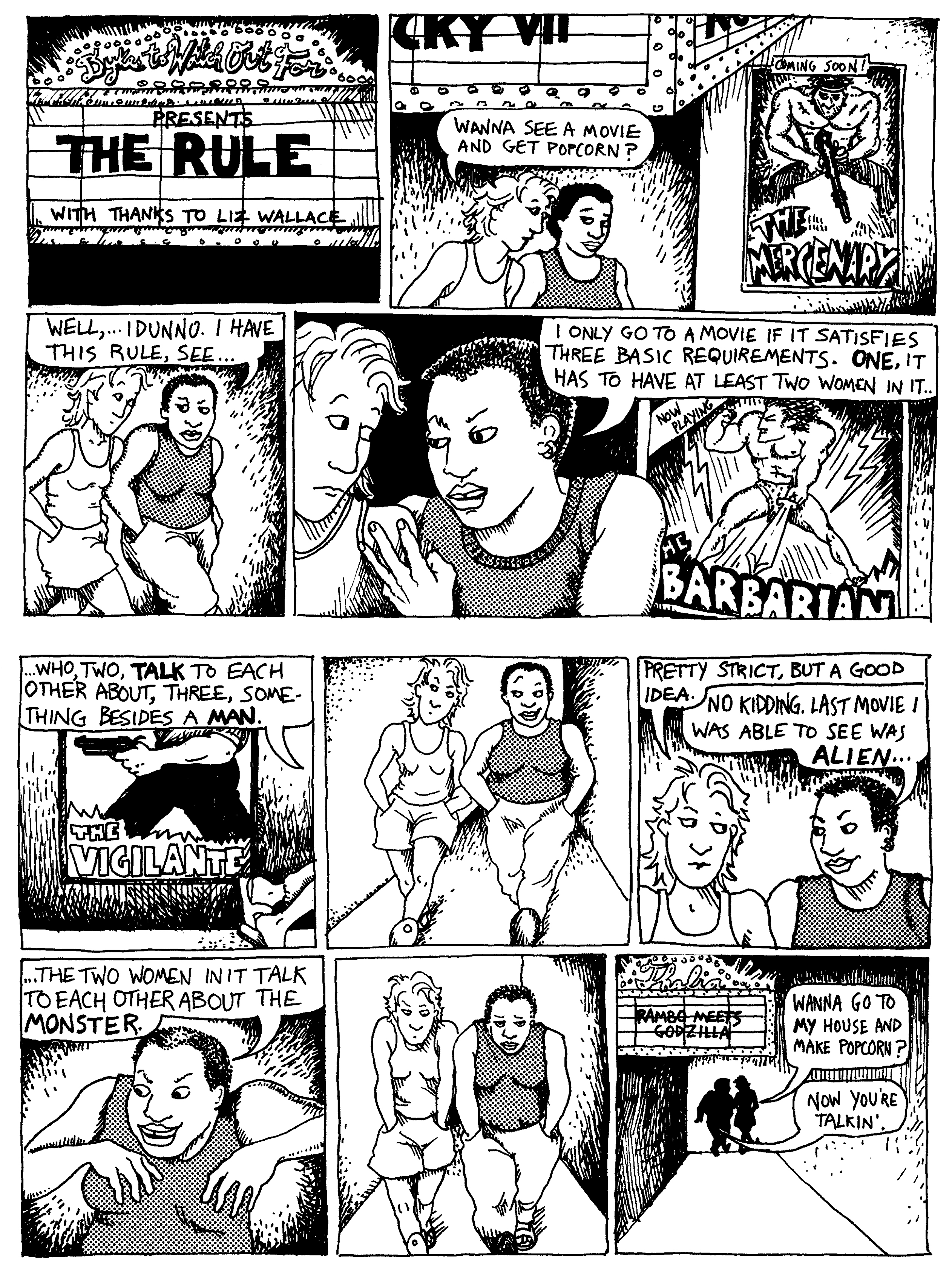
- The Bechdel test is a way to assess the representation of women in works of fiction, most often movies. There are 3 parts to this test: first, that there are 2 women in the work; second, that these women have a conversation; and third, that the conversation is not about men. This test first appeared in the 1985 comic strip “The Rule” in Dykes to Watch Out For by Allison Bechdel. This test calls attention to the one-dimensionality and side-lining that so often plagues female characters, and even after 40 years so many new movies still fail to pass the test. Despite creating the comic strip, Bechdel does not take credit for the terms of the rule, citing her friend Liz Wallace and the writings of Virginia Woolf as inspiration for the comic. Dykes to Watch Out For, published in various feminist and queer newspapers and magazines, ran from 1983-2008 and is one of the earliest consistent representations of lesbians in the media. “The Rule” persists as one of Bechdel’s most famous contributions to popular culture, entering the conversation anytime a new movie gets released and acting as a critical measure of female representation in movies, TV shows, books, plays, and other works of fiction.
***
Nikita Redkar, (@nikitadumptruck), Instagram,com/nikitadumptruck
- Continuing my submissions to the Feminist Killjoy Toolkit, I nominate Nikita Redkar, a social media influencer, educator and activist. Most recognizable by her Instagram handle @nikitadumptruck, she also posts on TikTok and YouTube (also @nikitadumptruck). Nikita began posting educational videos to Instagram in February 2023; her style is often satirical/humorous, utilizing modern slang/trends to explain current events, connecting sociological, political science or other academic ideas to pop culture. When not educating through Insta reels, Nikita is very involved with her local NYC politics, joining/volunteering with political campaigns like Zohran Mamdani’s 2025 mayoral campaign. Her videos often highlight the importance of community action, solidarity with minorities and the power of the everyman. What makes Nikita a distinct feminist killjoy is her refusal to give up her personality and style in exchange for approval. Beginning her series “Bimbo University” in 2023, Nikita is often doing/acting traditionally feminine, (putting on makeup, dressing in pink clothing) while playing into the character archetype of the “bimbo”. Colloquially known as a hot, dumb woman (usually blond) who are obsessed with fashion and material things. Nikita challenges this by framing her (well researched) videos through the framing of a bimbo’s understanding of concepts, thus showing that socially feminine traits are not inherently stupid. This approach re-frames the archetype, much like Sara Ahmed’s reframing of the feminist killjoy. It is this reclamation of a negative caricature, to create community and to inform other ‘bimbos’ about their power in the world, that outlines Nikita Redkar as a modern Feminist Killjoy.
***
Emma Watson
- Emma Watson is commonly known for her acting roles in the Harry Potter films, as well as Little Women, Beauty and the Beast, and The Perks of Being a Wallflower. However, she has taken on the role as a feminist activist alongside her career as an actress. In 2014, Emma Watson was appointed as a United Nations Women Goodwill Ambassador and gave her HeForShe speech at the UN headquarters, which launched the HeForShe campaign. Emma Watson and the HeForShe campaign advocate for gender equality, primarily achieved through active participation of men and boys. She points out that women’s rights is a shared humans rights issue. She continued this work in 2016 by starting a book club on Goodreads focusing on ways to explore gender equality through literature. The book club picks featured books by Gloria Steinem, bell hooks, Catilin Moran, Maya Angelou, and more. In 2016 and 2017, she was granted the Harper’s Bazaar Inspiration Award and the Elle Woman of the Year award for her contributions to feminism and inspiration to young women. Since her final Hollywood appearance in 2019, she has taken on more institutional roles. She joined the Kering board of directors as Chair of the Sustainability Committee, and launched the Time’s Up UK Justice and Equality Fund.
- For my fifth nomination for my feminist Killjoy, I decided to pick Emma Watson. The reason I chose her is that Emma spoke in 2014 about gender equality and the need for equal rights and opportunities for men and women. She explained that the goal of feminism is to create equality for all people, not to despise men. Men are also urged to support women’s rights by the ad. This is a great addition to the Feminist Killjoy Toolkit, in my opinion, because women are still faced with discrimination and unfair treatment. For instance, when women speak up, they may be labeled as bossy, whereas men may be viewed as leaders for doing the same thing. This shows how people’s expectations of men and women differ. Emma Watson’s explanation of how everyone should participate in feminism is also important, in my opinion. Women shouldn’t be the only ones who care about gender equality. Men can also contribute by advocating for equal chances and speaking up when they see unfair treatment. This speech, in my opinion, is an excellent approach to demonstrate to people that feminism is about justice and respect for all individuals
***
Dr. Clarissa Do Ó (or Dr. Clary)
- My next nomination for the Feminist Killjoy Toolkit is the Brazilian astrophysicist and influencer Dr. Clarissa Do Ó (or Dr. Clary). She moved to the US to pursue higher education, where she earned her bachelor’s from the University of California, Santa Barbara and her Ph.D. from UC San Diego. She currently works as a postdoctoral fellow at CalTech, where her work often involves collaborating with NASA. Nevertheless, her influencing work revolves around how she allows herself to express her individuality and style within her workspace, showing up to work with beautifully done make-up and incredibly “girlie” outfits, dominated by the color pink, high heels and dresses (she is basically astrophysicist Barbie). She openly talks about how she felt too uncomfortable to express herself in this way during her undergraduate years and how she has grown over the years and built the strength to not only express herself, but to encourage others to do the same. Despite the amazing support she receives from gender minorities in STEM, the presence of hate comments under her posts undermining her intellectual capabilities; work and character, illustrate that the world still needs this kind of figure to show that a woman can be both stylish and a brilliant scientist, without one impairing the other. I personally really look up to her as a woman currently doing research in astrophysics and potentially pursuing a career in that path who also likes to dress up and do bold makeup sometimes.Clary’s Instagram: @thatastrogirlie
***
Candace Parker
- I’m nominating Candace Parker for my third feminist killjoy kit. Candace is retired now, but she played in the WNBA and overseas for a long time. She was known for being one of the
best players ever in the WNBA. Felt like it was only right to add her to show the adversity she went through as one of the best players in WNBA history. Cadence started playing basketball
and receiving a lot of attention when she was very little. During her 16 seasons in the WNBA, she won 3 WNBA championships, Rookie of the Year, and was a 2-time MVP and 2-time
Defensive Player of the Year. Cadence was one of the biggest stars during her basketball career, inspiring kids all over the world that you can be anything you want to be with hard work.
But she did battle with a lot of things,s like not receiving the same attention as NBA athletes who were winning championships and MVPS. So Cadence started speaking across all platforms
on how important women’s sports are and the WNBA as a whole. Cadence has made women’s basketball more seen and heard, and to this day, even after her career, she is still helping the
WNBA and advocating for women’s rights. In my eyes, that’s a prime example of a feminist killjoy.
***
Billie Jean King.
- For my 4th nomination for my feminist killjoy, I am choosing womans tennis great Billie Jean King. She is a former womans tennis player and was very successful in her career. I felt like I had to pick her because on how she did so much for the sport and for woman at the time. She was known for being the best tennis player at the time and won a ton of times. She has 39 grand slam title wins, which are your main 4 events in tennis, she was ranked the number 1 player in the world during the 1996 tennis season, and she won her battle of sexes match in 1973 against a man named Bobby Riggs. During this time woman and men were treated very differently. Billie Jean was a massive advocate for woman sports, and she was so passionate about it. Always calling out the press for not receiving the same media coverage and prize money. She was the one her lobbied the major, even called the US open for equal prize money in 1973 and it
worked. It was the first time a major event offered equal pay in both mens and womans competition. This was a no brainer for me because she really did so much for the game of Tennis and the world showing all young Woman that if they are being treated unfairly or not right speak up. Speaking up can only help you and being silent will never help you. For her outspoken and bravery she received the president medal of freedom.
***
Becca Rea-Tucker [@thesweetfeministLinks to an external site.] Instagram
- For my next Feminist Killjoy Toolkit submission, I am selecting the food blogger and Grinnell College alum Becca Rea-Tucker. I chose Rea-Tucker, also known as @thesweetfeministLinks to an external site. on Instagram, because she is an outspoken feminist and reproductive rights activist who also engages in work often seen as typically “feminine.” Whilst one could argue that Rea-Tucker is simply following the role expected of her as a woman, I believe that using baking as a tool to push for women’s rights is an act of subversion against the very systems that try to confine women to strict roles in society. By using baking to advocate for herself and others, as well as to educate, Rea-Tucker is reclaiming the act of baking. This reminds me a lot of the conversation we had in class about the movie Kramer vs. Kramer. Whilst Ahmed enjoyed the film, she also recognised the highly problematic storyline it was pushing. As such, Ahmed brought up the problematic ideas the film was perpetuating. Doing so didn’t have to take the joy out of watching the movie—the movie brought Ahmed joy and also had problematic elements; both could be true. The same goes for activities such as baking—whilst baking has historically been a “woman’s activity” due to societal norms, one can also question such restrictive norms and even invert them, so a historically belittling and repressive tool can be used to empower women.
***
Katie Ledecky
- My next nomination for the Feminist Killjoy Toolkit is Katie Ledecky. She is the most decorated female swimmer ever, and is considered by some (but probably not enough) to be the greatest swimmer of all time. Although many people might think of Michael Phelps as the greatest swimmer ever, as he does hold the most Olympic gold medals and total metals, his dominance does not approach that of Ledecky. She made her Olympic debut at only 15, winning gold in the 800m freestyle, and coming only half a second shy of breaking the world record, which she now holds. Until the Pan Pacific Championships this August, she had gone undefeated in the event for 16 years, with 13 consecutive major international gold medals. In addition to the world record, she holds 4 of the 5 fastest 800m freestyle long course times and 18 of the top 25. These performances span from 2016 through 2026, including having broken her own world record last year. She remains the only woman to swim the event in under 8:05. She additionally holds the world records on the 1500m freestyle short and long courses, where her dominance is even more complete, holding 24 of the 25 fastest 1500m long course times ever. While Michael Phelps is certainly better known, Ledecky kills his joy of being the greatest swimmer ever with her complete and utter dominance.
***
Rachel Entrekin
- My next nomination for the Feminist Killjoy Toolkit is Rachel Entrekin. She is an ultramarathon runner who made history in May by breaking the women’s course record for the Cocodona 250 Mile race in Arizona, completing the race in 56:09:48, more than 7 hours faster than she had run it the previous year. Additionally, she beat Kilian Korth, who set a new men’s course record, by well over an hour, winning the race outright and becoming the first woman to do so. In an interview after the race, she said that her mindset was, “If anyone’s going to win this, why can’t it be you?” This approach helped her kill masculine joy by demonstrating that women are fully capable of competing with and beating men in long-distance running. She also said of her approach, “Maybe even especially women, we tend to talk ourselves out of even trying to do things because we think that we’re not qualified or we don’t have the experience or whatever. But why not? Why not try?” Here she is encouraging other women to follow in her footsteps, killing societal joy that stems from viewing men as physically superior to men, and trying to disprove that stereotype.
***
Μάδγα Φύσσα (Magda Fyssa)
- I would like to nominate the Greek antifascist activist Μάδγα Φύσσα (Magda Fyssa) for the Feminist Killjoy Toolkit. She is a 66-year-old mother whose (also antifascist) son, Pavlos, was murdered by George Roupakias, a member of the then far-right Greek political party Χρυσή Αυγή (Golden Dawn), in 2013. Fueled with grief and disappointment in systemic injustice, she played a vital role in the 7-year legal pursuit of classifying Golden Dawn as a criminal organization (for her son’s murder as well as further racist and fascist crimes) and kicking them out of parliament. Ever since her son’s death, she has dedicated her life to his remembrance and, despite having public opinion on her side, she has had to face extremely offending, dehumanizing and traumatizing insults and pushback from Golden Dawn supporters. Nevertheless, she keeps fighting for the antifascist movement, showing strong passion and drive for all relevant matters. She has become a symbol of the fight against fascism in the country as an extraordinary example of the impact a single mother can make. Her and her son’s names are always heard in antifascist protests through slogans up to today, and will continue to be as fascism issues continue in Greece.
***
Hannah Einbinder
- For my next nomination to the Feminist Killjoy Toolkit, I would like the nominate Hannah Einbinder. She is a actress, comedian, and activist, who advocates for mental health and LGBTQ+ rights. She also has been very vocal in fighting for Palestinian liberation. Within the acting industry, sometimes people with platforms stay quiet on controversial topics, but Hannah Einbinder uses her platform to condemn what is happening in Gaza. Recently, she was arrested during a protest in NYC alongside other celebrities. I think it is powerful that celebrities are using their platforms to draw attention to the issues that matter and try to make a change. At the Cannes Film Festival this year, she talked about the cost of not speaking out being much greater than losing her Hollywood career. I found this extremely important because it shows that she acknowledges the platform she has and uses it to call attention to issues like ADHD awareness, bisexual visibility, and Palestinian liberation. I think that she fits the feminist killjoy because she is not afraid to disrupt the norms of celebrities by being outspoken. She also is a comedian who uses her humor as a way to resist against the oppression in our society. Something Ahmed talks about is how the feminist killjoy refuses to laugh along with everyday sexism. Hannah Einbinder uses her comedy in a satirical way to show how crazy societal standards of women are.
***
“Girlscarryingshit” Instagram, effective July 2021, https://policies.google.com/privacy.Links to an external site.
- For my 6th Feminist Killjoy Toolkit submission, I’m submitting the Instagram account girlscarryingshit. I think the account’s bio summarizes its purpose well and explains why I believe it belongs in the toolkit: “after thousands of years w/o pockets, non-men have evolved a superior grip to carry our shit.” By creating an Instagram account centered on women’s ability to carry “shit” in their hands, girlscarryingshit points out the ridiculousness and comedy of women’s trousers historically lacking functional pockets, while also highlighting women’s ability to adapt and prosper despite the hurdles they face daily. While the Instagram account is supposed to be ‘fun,’ I think it still draws attention to the persistent hurdles women face in everyday life. This reminds me of Sarah Ahmed’s discussion of joy. By making content about women and girls carrying shit, girlscarryingshit acknowledges how ridiculous the situation is and makes a joke out of it. In doing so, girlscarryingshit empowers women and brings them together through the lens of something that has historically been burdensome and constraining for women. In doing so, girlscarryingshit also disempowers and makes a joke of the misogynistic and patriarchal systems that made women have to adapt and learn to carry “shit.”
***
Dr. Assal Rad [X/Twitter: @AssalRad and IG: @AssalRad_]
- I submit a recommendation for not only the Feminist Killjoy Toolkit, but for the Feminist Killjoy Panetheon. A historian of the modern Middle East, Research Director at Media Integrity Center (MIC) and author of the critically acclaimed The State of Resistance: Politics, Culture, and Identity in Modern Iran (Cambridge University Press, 2022) and Don’t Say Palestine: How the Media Manufactured Consent for Genocide (Vintage, 2026), Rad has been a Killjoy of every blind, racist and Zionist mirage. In her most recent work, Don’t Say Palestine, Rad addresses the major news’ corporation’s complacency in the Palestinian genocide, as major news outlets perpetrate the Israeli governments lies, accept the innocent killings of civilians, ignore the murder of Palestinian (and non-Palestinian) journalists in the name of ‘being unbiased’; this ‘neutrality’ is nothing more than cowardice, as Rad expertly posits “The purpose of a free press is not simply to reflect the world as those in power see it, but to illuminate the truth which challenges that very power. In Gaza, the Western press failed this responsibility, and in doing so, it became complicit in the atrocities it was supposed to expose.” (pg. 107). Dismantling the lies perpetrated by Western media, Rad lives by, what I would argue is the most important Killjoy Maxim, “KILLJOY MAXIM: BE MALADJUSTED; DON’T ADJUST TO INJUSTICE!”.
***
pink_bits influencer on instagram
- An influencer I want to nominate is pink_bits on instagram, an artist who illustrates women bodies that in lines connect to social experiences. Through colorful and playful illustrations, the artist represent parts of women body parts and experiences, like menstrual cycle, stretch marks, and more. Pink_bits’s post came up on my for-you page, which is strange because the post is pretty old, like 2023, but it’s relevant to women’s ovulating experience. Her artwork normalized women’s feeling of turn on, as society has long suppressed women’s sexual desire. There’s this really weird societal notion that women are not as sexual as men, simply because it’s not conventional or that they’re supposed to act more ‘innocent.’ But to embrace women’s ovulation through artwork, is a way to challenge this narrow narrative. Moreover, I believe that her account is an example of feminist killjoy because she points out that women’s bodies and experiences are not only controlled by society, but also by social media. The artist has experienced Instagram removing or limiting visibility of her illustrations because apparently, women’s sexuality and marginalized bodies are too inappropriate. This truly raises questions about why should certain bodies be deemed as inappropriate, meanwhile shirtless men are normalized. Feminists then thus need to fight for both the basic rights of women, or conventionally attractive women, but we also need to pay attention to the marginalized ones (women of color, women with unique body parts or features, women with higher sexual needs, etc).
***
Vivian Jenna Wilson
- I would like to nominate 22-year-old American influencer Vivian Jenna Wilson, known for her bravery to come out as a transgender woman at the age of 16, estrange herself from her very unsporting father, Elon Musk, despite his extraordinary wealth, and legally change her name two years later. Since then, she has been receiving treatment for her gender dysphoria and freely expressing herself on social media, advocating for human and trans rights and universal basic income and health care as well as condemning wealth inequality and invasive technology (which her father actively reinforces). Despite her father’s overwhelming political influence globally, Vivian has been using her fame and platform for good and has managed to gain the support of the younger generations, especially left-leaning and queer youth. Her content and projects are very bold and outspoken. She has worked with publications such as Teen Vogue in 2020, where she shared her experience coming out, and, most recently, the Spanish fashion label Desigual in 2026, where she promotes the “Born to Disobey” campaign by challenging her father’s ideologies and actions regarding artificial intelligence, claiming it is depriving creative jobs from capable artists and stripping art of the emotion that makes it human.
***
Angela Y. Davis
- Angela Davis is an incredibly well-known and renowned activist, philosopher, and academic, of the 1960s and 70s. She was and still remains an American feminist political Marxist and fights for prisoners rights, women’s freedom, and anti-racism within the United States. During her early life, she was an active member of the Communist Party of the United States (CPUSA) as well as involved with the Black Panther Party in the 60s who fought for Black liberation. In 1970, Davis was arrested due to accusations surrounding her involvement with kidnapping and murder; this led to nation-wide protests and the “Free Angela Davis” movement, later leading to her release from prison and to her becoming legally acquitted of all the charges. Davis is also world-renowned author, with popular titles such as “Women, Race, & Class” published in 1981, which spoke of the ways in which racial and class differences were separating and discriminating against marginalized women within the women’s rights movement. In the modern day, she continues to advocate for women, Black liberation, the abolishment of the prison system, anti-capitalism, and LGTBTQIA+ rights. She serves as professor emerita in the History of Consciousness and Feminist Studies departments at the University of California, Santa Cruz and travels globally to advocate and educate others on abolitionism and feminism. When I think of the feminist killjoy, my mind often goes back to the works of Angela Davis, who continues to fight for equality even in the face of persecution and resistance.
***
Alexandria Ocasio-Cortez
- I would like to nominate Alexandria Ocasio-Cortez for the Feminist Killjoy Toolkit because historically American politics has been dominated by men. I think that her journey is particularly inspiring as she started as a waitress and bartender in NYC, and became an important political figure that many young girls look up to. In politics, it often seems like political power belongs to corporate elites and people who come from money. However, AOC serves as a powerful disruption of this norm as she comes from outside the traditional wealthy political pipeline. In July 2020, when Ted Yoho approached AOC, calling her crazy and a “f***ing b****”. Many people expected AOC to ignore it, and not disrupt anything. However, AOC instead took the House floor and delivered an incredible speech, that forced people to reconsider how women are talked about and how normalized it had become. This speech condemning Ted Yoho was extremely powerful as she explained that the issue isn’t about one incident, but a culture of accepting violence against women and the power structure that supports this. She talks about attitudes towards women and the dehumanization of others. This speech exposes the systematic oppression of women, and I think is a great representation of what a feminist killjoy embodies. AOC is someone I look up to because she explains how men like Ted Yoho use women as shields to legitimize their behavior. AOC is such a strong women who inspires me to not accept misogyny from men.
***
Dolores Huerta
- For my seventh Feminist Killjoy Toolkit contribution, I would like to nominate Dolores Huerta. Huerta is a labor activist who helped co-found the United Farm Workers and spent much of her life fighting for better working conditions and rights for farmworkers. What stands out to me
about Huerta is that she was willing to speak up in spaces where women, especially Latina women, were not always given the same opportunities to have a strong political voice. She helped organize strikes and boycotts, pushed for better pay and treatment of workers, and continued advocating even when it made powerful people uncomfortable. I think this is what
makes her fit so well into the Feminist Killjoy Toolkit. Huerta refused to accept the idea that unfair treatment was just something workers had to deal with, and she also challenged the expectation that women should stay in the background of political movements. Instead, she took
on a leadership role and helped organize people to demand change. Her activism shows that being a feminist killjoy can mean pointing out unfair systems that other people have gotten used to and refusing to let those problems be ignored. Huerta also shows how feminism can connect
with other issues like race, class, and workers’ rights. To me, she is a strong example of someone who used her voice to challenge what was considered normal and helped create change for people who were often overlooked.
***